
What Is Compartment Syndrome?
The “Too Much Pressure = Big Problem” Situation
Okay so here’s the deal.
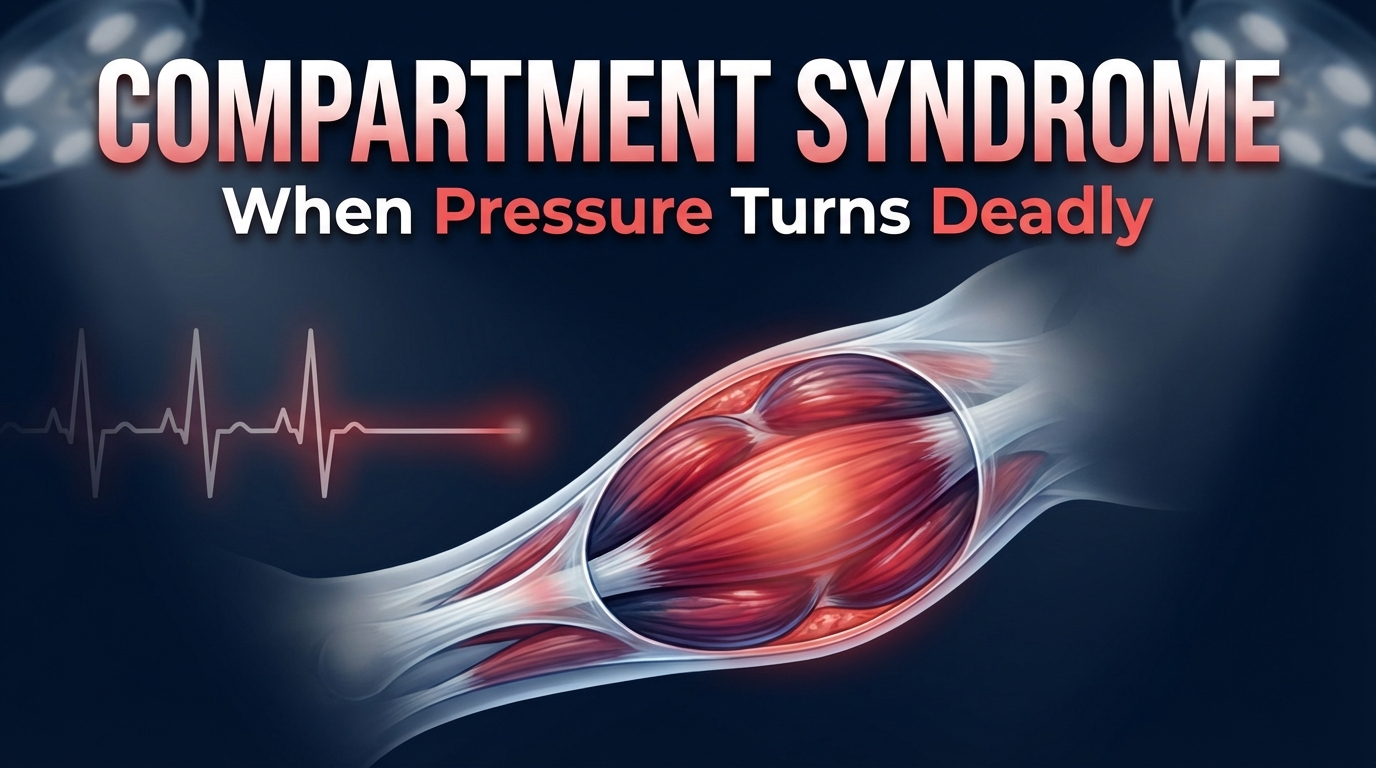
Compartment syndrome is when pressure builds up inside a muscle space (called a compartment — basically a group of muscles wrapped in tight tissue).
That wrapping is called fascia (a super tough layer of connective tissue that does NOT stretch — think shrink-wrap around your muscles).
When swelling happens inside that space, there’s nowhere for it to go.
So the pressure rises.
When pressure gets too high:
- Blood can’t flow properly
- Oxygen can’t reach muscles and nerves
- Tissue (body cells) starts dying
If nobody treats it? It can lead to:
- Permanent damage
- Gangrene (when tissue dies and turns black because there’s no blood flow)
- Even losing a limb
Yeah. It’s that serious.
How Does Compartment Syndrome Happen?
Your arms and legs are divided into these muscle compartments. They’re like little sealed rooms.
Now imagine something causes swelling inside that room:
- A fracture (especially the tibia — your shin bone)
- A crush injury
- A super tight cast
- Heavy bruising
- Blood rushing back into tissue after blockage (reperfusion injury — when circulation returns and causes swelling)
- Intense repetitive exercise
All that fluid builds up.
If the pressure inside that compartment becomes higher than your blood pressure (the force pushing blood through your vessels), circulation drops.
No blood flow = no oxygen.
No oxygen = tissue death.
And if that keeps going? Hello gangrene.
Acute Compartment Syndrome (Medical Emergency)
This is the scary one.
Acute compartment syndrome happens fast — usually after trauma — and it needs surgery ASAP.
Like… hours matter.
The 6 P’s (Doctors Love Their Mnemonics)
The 6 P’s of Compartment Syndrome
These are classic warning signs:
- Pain out of proportion (way worse than expected)
- Pallor (pale skin)
- Paresthesia (tingling or numbness)
- Paralysis (can’t move the limb)
- Pulselessness (weak or no pulse)
- Poikilothermia (limb feels cold)
⚠️ BUT here’s the tea ☕
By the time you see the last few P’s? It might already be advanced.
The earliest and biggest red flag is:
👉 Severe pain, especially when someone stretches the muscle for you (called pain with passive stretch — meaning someone else moves it and it hurts badly).
Untreated for a few hours?
Muscle and nerves can die permanently.
🔎 Acute Compartment Syndrom Study Findings:
This landmark review explains the pathophysiology of acute compartment syndrome.
📌 Key Findings:
- Compartment syndrome occurs when intracompartmental pressure rises high enough to reduce capillary blood flow.
- Tissue ischemia (a lack of blood flow to tissue, causing it to not get enough oxygen). begins when compartment pressure approaches diastolic blood pressure.
- Muscle and nerve damage can occur within 4–6 hours of sustained ischemia.
- Delayed treatment leads to irreversible necrosis and functional loss.
🧠 Why It Matters:
This paper established the core concept that pressure impairs perfusion, which remains the foundation of diagnosis and treatment today.
Leg Compartment Syndrome
The lower leg is the main character here.
Why?
Because tibia fractures (shin bone breaks) are super common in trauma.
When this happens, you might notice:
- Swelling that feels tight
- Shiny stretched skin
- Intense pain
- Numbness
- Weak foot movement
If untreated → nerve damage + muscle death.
Not cute.
Chronic & Exertional Compartment Syndrome
Okay now this one is different.
Chronic compartment syndrome (also called exertional compartment syndrome or CECS) usually happens in athletes.
It’s not sudden trauma.
It builds up during exercise.
You’ll see:
- Tightness during workouts
- Achy shin pain
- Numbness that goes away when you rest
It’s often confused with:
- Medial tibial stress syndrome (fancy name for shin splints)
- Anterior shin splints
The difference?
Compartment syndrome pain gets worse the longer you push.
Sometimes rest fixes it.
Sometimes surgery is needed.
Delta Pressure Compartment Syndrome
Doctors don’t just guess, they measure the pressure inside the muscle using a needle device.
Then they calculate something called delta pressure:
Delta pressure =
Diastolic blood pressure (your lower BP number)
minus
Compartment pressure
If that number is 30 mmHg or less, it means blood flow is dangerously low.
Translation:
You probably need surgery.
🔎 Pressure measurement is critical:
Modern explanation of the relationship between pressure and tissue perfusion.
📌 Key Findings:
- As intracompartmental pressure rises, capillary perfusion decreases.
- Once pressure approaches diastolic blood pressure, ischemia accelerates.
- Persistent pressure elevation leads to necrosis and possible gangrene.
🧠 Why It Matters:
Strengthens your explanation of why pressure measurement is critical.
Abdominal Compartment Syndrome
Now imagine this happening in your abdomen.
Abdominal compartment syndrome is when pressure builds up inside your belly cavity.
Causes include:
- Major trauma
- Big surgeries
- Severe infection (sepsis — body-wide infection)
- Massive IV fluids
- Peritonitis (infection/inflammation of the abdominal lining)
High pressure there can:
- Damage kidneys
- Make breathing harder (lungs can’t expand)
- Reduce blood flow to organs
This is ICU-level serious.
The Surgery (Fasciotomy)
If it’s acute? Surgery is the only fix.
It’s called a fasciotomy.
What happens?
- Surgeons cut open the skin and fascia
- Pressure instantly drops
- They check if muscles are still alive
- Sometimes they leave the wound open temporarily
It looks dramatic.
But it saves limbs.
Early surgery = muscle survives.
Late surgery = permanent damage
🔎 Fasciotomy in the Treatment of the Acute Compartment Syndrome
This study evaluates outcomes of early vs delayed fasciotomy in acute compartment syndrome.
📌 Key Findings:
- Early surgical decompression significantly improves muscle survival.
- Delays increase risk of muscle necrosis, infection, and limb dysfunction.
- Fasciotomy effectively reduces intracompartmental pressure immediately.
🧠 Why It Matters:
This study helped define fasciotomy as the gold standard treatment for acute compartment syndrome.
how common is compartment syndrome?
It’s not super common overall, but:
- Happens in up to 10% of tibia fractures
- More common in young males
- Seen in high-energy trauma (car crashes, etc.)
Chronic version?
More common in runners and military recruits.
Don’t Confuse It With…
It can look like:
- Shin splints
- Deep vein thrombosis (blood clot in the leg)
- Peritonitis (in abdominal cases)
BUT shin splints don’t cause nerve problems or extreme swelling like this.
Compartment syndrome pain keeps getting worse.
When To Go To The ER 🚨
Go immediately if you have:
- Severe pain after injury
- Increasing tightness and swelling
- Numbness
- Weakness
- Pain not controlled by meds
Acute compartment syndrome is a surgical emergency.
Check out our article on weight loss programs whether they are affective.
Leave a Reply